The Economist lies about Islam. By Ayaan Hirsi Ali.
On the cover of its latest edition, The Economist promises to uncover “the truth and the lies” about “Islam in Europe.”
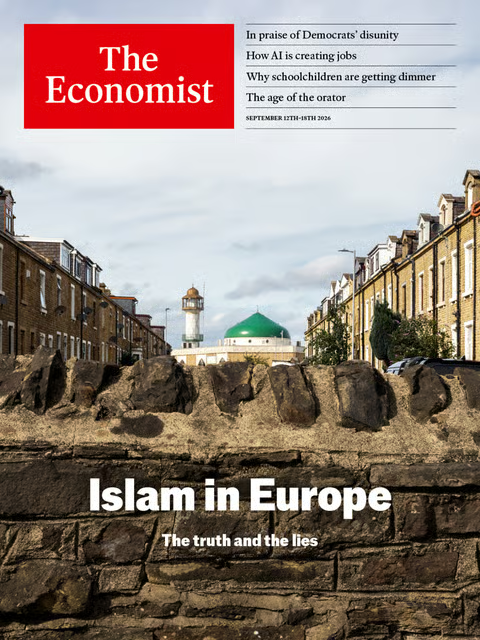
The story it presents is, for the magazine’s readership, a reassuring one: a crisis of two extreme fringes fighting across a sensible middle. But this is a false framing that betrays the complexity of Islam in Europe it promises to untangle, just when honest understanding is urgently needed. Allow me to explain why.
The editors offer a soothing symmetry: on one side, a small minority of Islamist extremists; on the other, a small minority of far-right extremists. “Islam poses no serious danger,” declares the accompanying editorial. “But Islamism and the fear of Islam do.” Both are dangerous. Both must be resisted. In this formulation, the vast majority of Muslims and the vast majority of native Europeans are peaceable people caught between two fringes.
Unfortunately, that symmetry does not reflect reality …. Consider what would have to be true for the symmetry to hold.
- There would have to be, on the European far right, a creedal architecture of comparable depth to Islamic scripture and tradition … There is not. The European far right has no scripture. It has memes, manifestos, a handful of self-published tracts, and a scattering of ideologues who cite one another. …
- There would have to be a recruitment base of comparable size. On the Islamist side, the recruiting field is the young men of a global community of about two billion people, of whom the middle classes alone number in the hundreds of millions, all of them potentially reachable through mosques, Quran schools, satellite channels, and university Islamic societies that exist in every European city. On the far-right side, the recruiting field is a scattering of subcultures made up of football-hooligan networks, online gaming communities, and obscure political parties that have never, in any European country, produced a mass following since the 1930s. They are aggressively policed by every European state, security service, employer, and mainstream media outlet. The two recruiting fields are not remotely comparable.
- There would have to be money of comparable scale. The Islamist infrastructure has been resourced, for 50 years, by well over an estimated $75 billion to $100 billion of Gulf state and private funding. It builds mosques by the thousand. It funds television channels, publishing houses, university chairs, and international NGOs. On the far-right side there is no equivalent. …
- There would have to be state power behind it. The Islamist current has, in Iran, an entire state built on its logic … It has, in Qatar and Turkey, two states that use their diplomatic, financial, and media apparatus to support the movement globally. It has, in Saudi Arabia, a state that spent decades exporting the doctrine and that even now, under a modernizing crown prince, still funds a religious establishment shot through with it. It has the Organization of Islamic Cooperation, a bloc of 57 states that consistently defends the movement’s political priorities at the United Nations. There is no equivalent on the European far-right side …
- And there is one final asymmetry, the one that ought to settle the matter once and for all. There is no flight from Europe by anyone … as a consequence of European far-right violence. No Muslims, no Jews, no atheists, no ex-Muslims, no gay men and women are packing suitcases in Frankfurt or Manchester or Marseille and applying for asylum in Cairo or Islamabad or Algiers because European far-right militants have made their lives untenable at home. The traffic runs, on a massive scale, in the opposite direction, and it has run in the opposite direction for two generations. Muslims, Christians, Yezidis, Baha’is, Ahmadiyyas, ex-Muslims, secularists, feminists, gay men and women, and religious minorities of every description are leaving the Muslim-majority world in millions, and they are coming to Europe and the rest of the West. They come because Europe, whatever else it is, is not governed by the doctrinal architecture they are fleeing.
During the Cold War, we knew the Soviet propaganda about the wonders of communism was false because people risked their lives to cross from East Germany to West Germany, but no one went the other way. Same here.
The direction of migration by itself — that is, the votes of feet cast in their tens of millions by the very people who know both worlds –is a stronger empirical statement about the relative danger of the two phenomena than any Home Office report, academic study, or half-baked media essay will ever be.
Why is The Economist — a reliable spokes-publication for the globalists — so crazy when it comes to Islam?
The Economist … would not write today that the Chinese Communist Party and the Falun Gong are symmetrical authoritarianisms. In every other domain, this magazine understands that variables such as scale, state sponsorship, and institutional depth matter; that a movement with a coherent multigenerational strategy is not the same kind of thing as a collection of aggrieved amateurs. On this subject, uniquely, the analytical standards slip. It is worth asking why.
The answer, I suspect, is that the movement itself has spent decades constructing the very framework within which the Economist editorial was written. Its second prong, after the doctrinal one and before the militant one, is a soft-power infrastructure of charities, NGOs, media relations, lobbyists, legal-defense funds, and university programs whose principal purpose is to ensure that any serious criticism of the movement can be immediately reframed as Islamophobia against Muslims as a whole. The Economist delivers that framing on a plate.
When will they wake up? When Islam invades their comfy neighborhoods?
A reader adds:
Ayaan H. A. is totally right. It always amazes me, given her background and credentials, that the craven, weak, foolish western progressives don’t actually listen to her. I mean: she’d know, wouldn’t she? And they don’t — how could they? None of them has experience comparable to hers
It’s a good example of progressive westerners projecting themselves onto something which is completely different from them. “Muslims are people and we’re people therefore they’re just like us. So how can there be a problem?” It’s progressive westerners making things up, as usual. That’s very dangerous in the long run.
The big give-away that the progressives are totally wrong is the one-way traffic from Muslim countries to ours.