Australian-designed small nuclear reactor and landing craft both succeed for the US, but Australia’s Labor Government didn’t want them. By Robert Gottliebsen in The Australian.
Today I reveal yet another defence bungle. We have contracted to spend $4bn building landing craft in WA using overseas designs instead of using superior and lower-cost, locally designed landing craft.
But the US marines may have come to the rescue. They recognised our mistake and have leased an Australian-designed landing craft which they kindly called Matilda to tour the Pacific islands to show how Australia’s well-designed landing craft can help people manage the impact of cyclones and storms.
But this tragic Australian saga goes way beyond the design of landing craft. The Australian landing craft designers realised that to be really effective, it needed to be powered by a small nuclear-driven generator rather than diesel motors.
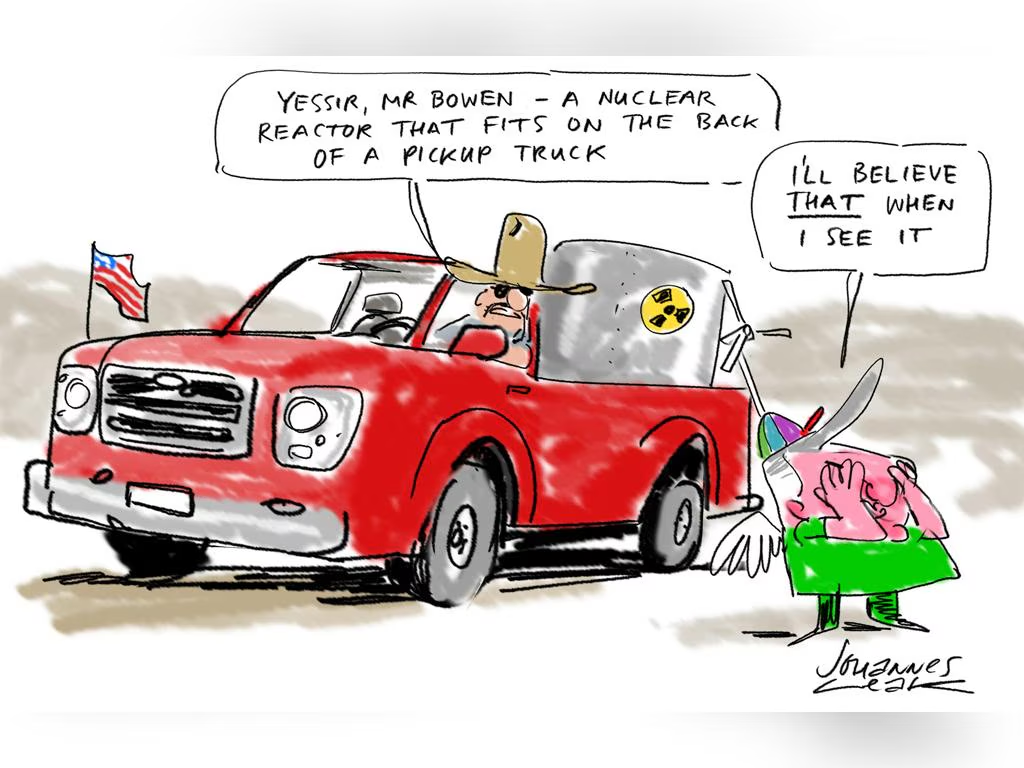
The chief of the nuclear section of the Queensland landing craft design operation, Bobby Gallagher, recruited top nuclear scientists from the ANSTO Lucas Heights nuclear facility in Sydney, plus Queensland engineers, to design a unique nuclear-powered generator that could be carried on the back of a utility truck and operate in the size of a container (Matilda can carry 84 containers).
But when Peter Dutton lost the 2022 election, it meant the Australian nuclear design could not be tested in Australia, so Bobby Gallagher took the technology to the US. …
The NT exercises confirmed to the Americans that the Australian-designed vessels are brilliant for landing tanks, containers, troops and heavy military equipment on beaches. …
But the Pacific island communities want Matildas for cyclone and similar storm disasters. They also want nuclear power so they can quickly reach a disaster zone and supply electricity to communities where a cyclone has cut off power.
Once again, Australian-developed technology — albeit now taken to the US — has come to the rescue. It makes you feel proud that we can use Australian-sourced landing vessel technology plus our nuclear skills to help Pacific island communities while creating a vessel that will be invaluable in modern warfare.
But now the story turns very sour because Australian defence bureaucrats turned their backs on our proven landing craft technology and awarded a $4bn contract to build vessels in WA based on Dutch technology.
Back to the Australian small modular reactor (SMR):
July was an amazing month. While the Americans were testing Matilda in Darwin, ready to display it to the region, Bobby Gallagher’s so-called Unity Nuclear Battery was wheeled into the Idaho National Laboratory, where it became the third new US reactor to achieve criticality as part of the US-planned moonshot.
As Graham Lloyd explained, the Australian-designed Unity Battery, now owned by Gallagher’s US company Deployable Energy, uses a 1MW microreactor that can run for five years without needing to be refuelled.
It is easily transportable and can be run in series to power a single industrial facility, a ship, an island or a mine site, or be scaled up further to underpin a small city or a major data centre. It does not require water for cooling, can be buried underground, can replace gas to back up renewables and uses only a tiny fraction of the land needed for other power sources to generate the same output.
A mobile nuclear reactor built in 150 days.
Of no interest to Australia’s Labor Government, but now a success in the US.
Gallagher aims to have 100,000 nuclear batteries deployed by 2040, with a target cost of $0.05 per kWh (your retail electricity currently costs around $.30 per kWh, six times as much).

An Australian-designed nuclear battery on the back of pick-up, in the US.