Foolish Albanese doesn’t understand the pricing of risk, so we all lose. By Janet Albrechtsen in The Australian.
This country was built on the back of risk-takers. From explorers like James Cook and Matthew Flinders to military men like John Monash, the risk-takers have left a mark for the better on this country.
Australia has flourished from farmers taking risks on the land, and migrants boarding ships to a country they knew little about. In business, too, the risk-takers have transformed Australia, from miners like Lang Hancock to media titans such as Rupert Murdoch and Kerry Packer.
The risk-takers aren’t all big names. The country has 2.5 million small businesses, meaning an even larger number of Australians are taking risks every day. …
The Labor Party people who made this budget have no clue about business risk:
The Prime Minister is a former Labor Party official and research officer. Though the federal Treasurer has put Dr in front of this name, this has not added gravitas to his skill set. His CV, before taking charge of the Australian economy, was political adviser, academic researcher and chief-of-staff to Wayne Swan.
The Finance Minister was a community housing worker and ACT political staffer. The Foreign Minister was a union lawyer, industrial officer, and policy adviser. The Defence Minister was a lawyer at ALP-aligned law firm Slater & Gordon and a union official. The Immigration Minister was a union organiser and industrial officer. The Education Minister was a policy adviser and political staffer.
In other words, no risk-takers there. No one with any clue about the pressures of being responsible for a profit and loss account, navigating business red tape, signing contracts with suppliers and creditors, dealing with workplace rules that invite litigation.
With no hint on their CVs of any previous experience understanding what it’s like to run a business, no wonder the budget is bonkers. …
Ideology takes the place of experience:
One of the hoariest myths in the socialist lexicon is that it’s “fair” to tax income from labour just the same as income from capital. This has its roots in the kind of class warfare and ideology we all thought had disappeared when the Berlin Wall fell. We had all hoped that while Albanese may have felt safe in telling the 1991 ALP national conference in a debate on inheritance tax that “accumulated income in the form of capital is for all socialists at least part of the source of many social injustices”, he had learned a bit more about the real world since then.
Sadly, no. …
Income and capital are very different. They have different sources and drivers and it is decidedly unfair to tax them in the same way or at the same levels. …
Capital gains are uncertain and require the taking of risk. Employment income is generally predictable, certain and risk-free.
It’s like the difference between equity and debt — one is high risk but potentially high reward (or no reward) while the other offers certainty and thus no upside or downside. No economically literate person suggests the cost of debt should be the same as the cost of equity.
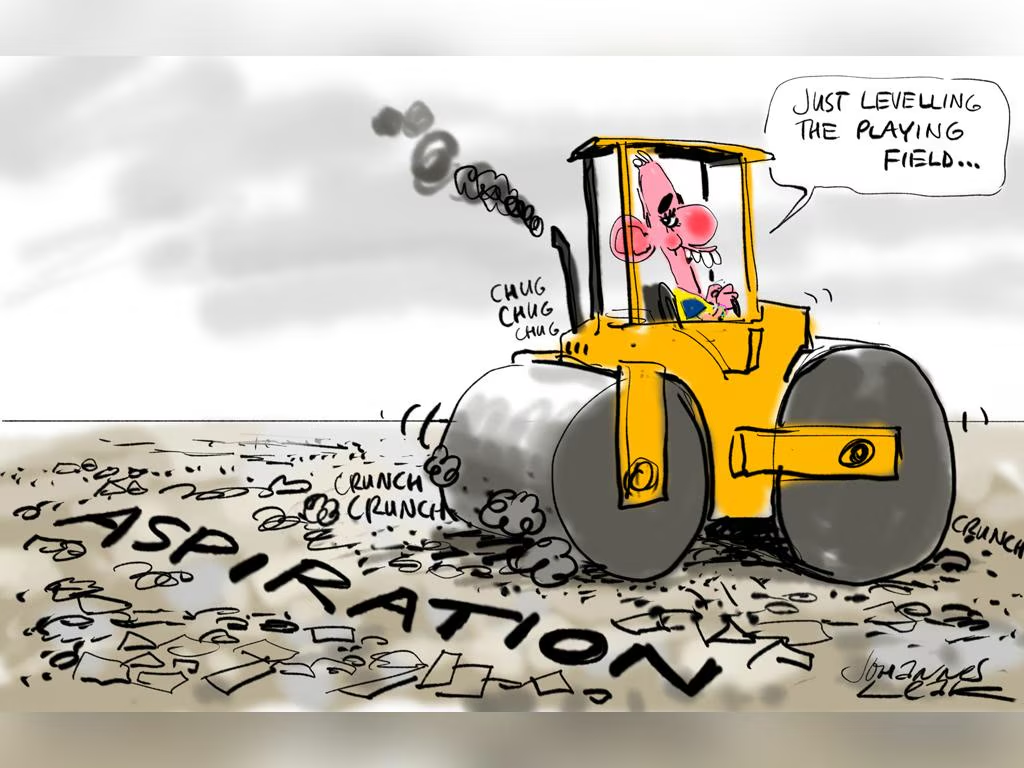
The Albanese-Chalmers taxation principle ignores human nature. Why would any sane person invest in a risky venture if the taxman treats you the same as if you invested in a risk-free venture? …
Without some incentive to take risk or to innovate by investing capital, new business growth dies, and the economy suffers. If you doubt this, talk to some of the venture capitalists and start-up entrepreneurs who are dismayed by the budget changes to capital gains tax.
Money will walk (By Brad Thomson in The Australian.)
Gina Rinehart says the Albanese government’s capital gains tax changes will ultimately hurt the federal budget bottom line as mining and other business investment moves offshore.
Mrs Rinehart said the tax changes were ill considered and left wage earners facing a double whammy if they chose to invest in mining to boost their wealth in what was already one of the highest taxing jurisdictions in the world. …
“These CGT changes will make it even harder for junior and medium explorers to raise the money needed to search for and develop new projects,” she told The Australian.
“Smaller and medium mining companies rely heavily on investors willing to back high-risk exploration years before there is any return. If you reduce the incentive and ability for people to invest, you reduce future discoveries, future mines, future jobs, future revenue and future growth for Australia at a time when our country sure needs it.
“Additionally, what is also being missed in the CGT increase is that people are investing money they have already paid tax on through PAYG and other taxes, and yet any profits they make on that reinvestment is now going to be subject to even higher taxes.”
Most financial scams work by mispricing risk. A high-risk product is sold as lower risk than it really is, thereby apparently justifying a higher price. The mark doesn’t know or can’t assess the risk accurately.
Albanese’s tax changes ignore risk almost completely, treating employees and investors the same. At one fell swoop, all investment activity has been penalized and all risks have been adversely repriced. Where it can, much of that money will now leave Australia. The outlook 20 years ahead is poor.