Today’s developing class structure. By Charles Hugh Smith.
A compelling taxonomy of class in America:
How do different groups in today’s America get their income?
1. Investment class: income from investments (i.e. capital)
2. Salary class: income from a monthly salary with benefits
3. Wage class: income from an hourly wage with no benefits
4. Welfare class: income from welfare programs
Greer argues that the salary class is now the gravitational center of power in the U.S., absorbing much of the national income in unproductive faux-problem-solving for fabricated problems explicitly devised to justify generous salaries and benefits.
The nation can no longer afford this staggeringly costly unproductive work force and so “replacing cognitive work with AI” is the cover story for the mass evisceration of this class, in a parallel to the previous gutting of the factory work force by automation and offshoring. …
The modern class structure — keeping it real:
This is a neofeudal society passing itself off as a free-market democracy. Power is concentrated in the top state-private sector classes. No one below has any real power. Electing another leader or party changes nothing: life gets more difficult, insecure and expensive for commoners regardless of who’s in office. The Imperial project grinds on, regardless of the delusional hope that electing someone else will change anything. Everything else is an illusion of power, not real power.
Try switching the 37% tax rate on labor to capital gains and all income from capital, and see how far you get. …
The essence of neofeudalism is debt penury and wage-slave bondage to the owners of the debt, which is capital that generates income. Commoners have no agency because they have to work for corporations or the state to service their debt. They can’t change jobs because they’ll lose healthcare insurance, and so on. …
Stripped of PR gloss, the majority of workers have a false choice of servitude: they can serve their current oligarch / state agency / corporation, or they can toil in another noble’s domain. Six one way, half-dozen the other. …
America’s neofeudalism now depends on inflating an endless series of credit-asset bubbles that generate phantom wealth, financial claims that are easily inflated without actually creating any real value via increasing income streams by means other than inflation and monopoly extortion.
This has worked so well for so long that recency bias has kicked in and we now believe this is a well-oiled permanent mechanism we can rely on. Alas, credit-asset bubbles are inherently unstable and the current system-wide bet on AI being something that will actually generate value / massive new income streams is an all-in last-ditch bet. When this bubble pops, the conditions enabling a future bubble will no longer exist.
In other words, you have to own assets and get capital gains to get ahead financially, or have a very high salary.
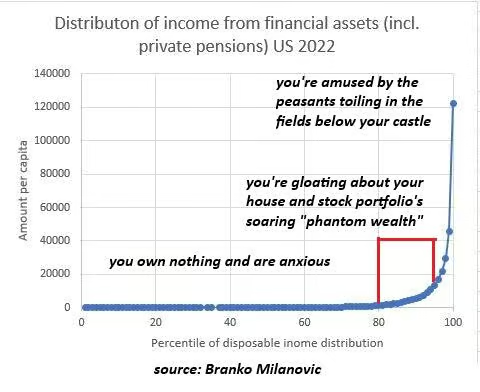
Here is a chart of the income distribution from owning capital. Note that it follows a power-law distribution: the few collect the lion’s share of the income generated by capital. The vast majority don’t own any income-generating capital, and the top 20% are delighted by the steady rise in their phantom wealth as the bubble-du-jour inflates the nominal price of the assets they own, setting up the inevitable crash when tulip bulbs revert from “investments” to flowers.
All this is because money is created out of thin air to buy assets with debt. Participate in that system, and you accelerate away from everyone else financially. Fail to participate, and you become a wage or salary earner, or on welfare –a modern day serf. Naturally, the guys with all the assets and capital income make the rules.
Fix the money system. Restore sound money. Neofeudalism will fade away, people will be able to afford houses again, and fertility will recover.
And the parasitic bureaucratic class would wither away:
Much of the work Greer describes as unproductive is considered highly productive because our exploitation of hydrocarbons and technology has generated such a vast surplus that we could spend it on symbolic work — meetings about meetings, compliance reports, marketing plans, projections, consulting, and so on, work that despite claims to the contrary has little to do with harvesting grain, connecting pipelines, replacing transformers, making beds, performing surgery or any other real-world work.
Try telling the priesthood of the temple gods that their work is symbolic. Ours is the most valuable labor, as we’re the ones keeping the whole thing glued together. If we stop, the gods will be angered and all will fail. Indeed.

“The gods will be angry unless you do as we say” game is a very old one